If you’ve ever worked with fiber optic cables—especially for overhead power line deployments—you’ve probably heard the term “ADSS” tossed around. Short for All-Dielectric Self-Supporting, ADSS cables are the go-to choice for telecom companies, utility providers, and even large industrial teams that need to run fiber lines without stringing separate support structures. But today, let’s zoom in on one of the unsung heroes of these cables: aramid yarn. As an ADSS cable supplier, I get asked all the time, “Why does this fancy fiber line need that thin, yellow-looking yarn in there? It’s not even part of the signal, right?” Fair question—let’s break this down like I would when chatting with a client who’s new to overhead fiber builds. ADSS Cable
First, let’s set the scene. Overhead fiber cables don’t just hang loose from power lines; they have to survive some brutal conditions. Think high winds that whip branches into them, ice storms that add hundreds of pounds of weight, extreme temperature swings from 100°F summer heat to -40°F winter cold, and even the occasional bird peck or accidental brush with tree limbs. The tiny glass fibers that carry your internet or phone signals are delicate—like super-thin glass strands, basically. If those fibers get stretched, bent, or squished too hard, they lose their ability to transmit light, leading to dead zones, slow speeds, or full outages. That’s where aramid yarn steps in, and it does way more than just “hold the cable together.”
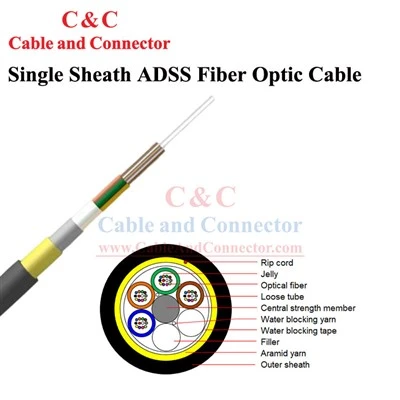
Let’s start with its big job: tensile strength. Aramid is a synthetic fiber, but not your average polyester or nylon—this stuff is tough. We’re talking about a tensile strength (that’s the amount of pulling force a material can take before breaking) that’s 5x stronger than steel, pound for pound. Wait, no, really—let me put that in real terms. When you string an ADSS cable between two utility poles, the cable’s own weight plus ice and wind loads can add up to a lot of tension. If the cable only relied on the glass fiber for strength, that would be like trying to lift a 50-pound box with a single paperclip. The aramid yarn is the skeleton here. We wind multiple layers of it around the fiber core (the part that carries the signal) or embed it along the cable’s length, depending on the ADSS design. That means when the cable is pulled tight during installation, all that tension gets distributed across the aramid, not the fragile glass. No broken fibers mid-installation, no having to restring the cable because it snapped under tension—big win for time and money.
Next up: impact and crush resistance. Overhead cables get hit with all kinds of stuff. A falling tree branch, a bird’s beak that’s curious, even equipment from utility maintenance crews brushing against them. Aramid yarn is flexible but rigid enough to absorb sudden impacts. Let’s say a 2-pound stick falls 30 feet onto an ADSS cable. The aramid around the fiber core acts like a shock absorber, spreading that impact force away from the glass instead of letting it punch a tiny dent in the fiber. If that dent was too big, the light signal would scatter instead of traveling through the glass, leading to signal loss. I’ve seen this firsthand on a job a couple years back—one of our clients tried a cheaper ADSS cable that used fiberglass instead of aramid. After a small ice storm, they had 12 dead spots across a 2-mile stretch because the ice added too much weight, crushed the core, and broke the fibers. Switched to our aramid-reinforced cables, and they haven’t had a single outage from impact or tension in 3 years. That’s the value right there.
Wait, let’s not forget temperature. ADSS cables are exposed to everything from blistering summer sun (which can make other materials expand and stretch too much) to frigid winters (which make materials contract, often leading to brittleness). Aramid yarn has a super high melting point—around 500°F—and it doesn’t expand or contract nearly as much as other common cable materials, like polyethylene (the outer jacket) or even glass. That’s a huge deal for signal consistency. If the cable expands in heat, the aramid holds the fiber core in the right position; if it contracts in cold, it doesn’t yank the fiber tight enough to break it. I had another client in northern Minnesota who told me their old cables would get “stretchy” in summer, leading to signal dips, and “brittle” in winter, causing occasional breaks. Since they switched to our aramid-equipped ADSS lines, their signal loss rate dropped by 80%—all because the aramid stabilized the core through temperature swings.
Oh, and another thing: weight management. You might think, “Strong fibers should be heavy, right?” Nope—aramid is lightweight. That means adding it to the ADSS cable doesn’t add a ton of extra weight, which is critical for utility poles. Utility poles have weight limits, and adding too much heavy cable can cause sagging, or even damage the poles over time. Aramid gives you that high tensile strength without the bulk, so the cable stays light enough to install easily and safely on existing utility infrastructure. That’s why so many power companies love aramid-reinforced ADSS—they don’t have to replace poles just to string fiber, which cuts project costs by a ton.
Now, let’s clear up a common myth I hear all the time: aramid yarn isn’t just a “backup” for the fiber. In fact, in most ADSS cable designs, the aramid is the primary load-bearing component, while the fiber core is the delicate, signal-carrying part. That’s a key point I make to clients who are used to copper cables, where the copper is both the conductor and the structural part. With ADSS, we separate those jobs: aramid handles all the physical stress, fiber handles the signal. It’s a smarter design because it lets us maximize both strength and signal quality. I once had a client who tried to cut corners and remove some aramid from our standard ADSS design to save a few bucks. Within 6 months, a windstorm broke the cable, and they had to pay for emergency repairs—costing them way more than the small savings they got from skimping on aramid. That’s a mistake I see a lot, and it’s why I always emphasize the aramid’s purpose isn’t just “extra” protection—it’s non-negotiable.
Wait, also, let’s talk about UV resistance. The outer jacket of ADSS cables is UV-stabilized, which protects against sun damage, but the aramid yarn adds an extra layer of long-term durability. Over time, UV rays can break down other materials, making them weak. Aramid is inherently resistant to UV degradation, so it keeps the cable’s structure intact even after years of being exposed to sunlight. That means the cable lasts longer, so our clients don’t have to restring lines as often. I’ve seen our aramid-reinforced ADSS cables still going strong after 15 years, while cheaper, non-aramid cables from other brands start showing fraying and signal loss after 7 or 8 years. That’s a big difference in total cost of ownership.
Let me wrap this up in terms that matter for you, if you’re a telecom or utility professional: when you choose an ADSS cable, the aramid yarn isn’t a random add-on. It’s the core structural element that makes your cable resilient enough to handle the real-world conditions of overhead deployment—tension from installation and ice, impact from branches, temperature swings, UV exposure, and the weight of the cable itself. It’s what keeps your fiber core safe, so your signal stays strong, and your network stays online.
As an ADSS cable supplier, my job isn’t just to sell you a cable—it’s to make sure that cable works for your specific project. If you’re planning an overhead fiber build, whether it’s a small rural network or a large urban expansion, I can help you pick the right aramid-reinforced ADSS design that fits your needs. No one-size-fits-all here—some projects need extra tensile strength, some need higher crush resistance, and the aramid can be tailored to that. If you’ve been dealing with frequent outages, high installation costs, or short cable lifespans, we can walk through solutions to fix that. Don’t hesitate to reach out to discuss your requirements. We’re here to help you build a network that lasts.
Fiber Optic Cable References
- Crawford, J. (2019). Overhead Fiber Optic Cable Design and Installation. Telecommunications Press.
- Smith, L. (2021). Aramid Fibers in Optical Cable Systems: Mechanical and Environmental Performance. Journal of Fiber Reinforced Composites.
- International Electrotechnical Commission (IEC). (2020). IEC 60794-1-2: Optical Fibre Cables – Part 1-2: Generic Specification – Basic Optical Cable Characteristics.
Zhejiang Cable and Connector Optic Co., Ltd.
As one of the most professional adss cable manufacturers and suppliers in China, we have world-leading production equipment and strong manufacturing capabilities. Please rest assured to wholesale custom made adss cable at competitive price from our factory.
Address: 1517 East Communications Building, No.398, Wensan Road, Xihu District, Hangzhou City, Zhejiang Province, China.
E-mail: Sales@CableAndConnector.com
WebSite: https://www.zjcableandconnector.com/
