Hey RV Fam, let’s cut to the chase: if you’ve ever spent hours troubleshooting a wonky 12V interior light that just died mid-camp, or stared confused at a blown fuse panel while your portable fridge shuts down right before dinner, you know how much tiny, often-overlooked parts make or break a good time on the road. Today we’re talking about DC energy fuses for RVs—specifically the million-dollar question I get asked every single day at my shop: “What size do I actually need?” DC Energy Fuse

I’m not here to hit you with that boring, textbook-style math that makes your eyes glaze over. I’m a DC energy fuse supplier who’s installed these things in everything from retro 1970s Airstreams to full-timer sprinter vans, so I’ve seen way too many people grab the first fuse off Amazon that “looks right” and end up with bigger headaches. Let’s break this down like we’re sitting around a campfire with a cold seltzer, no jargon allowed.
First, let’s get one non-negotiable fact straight: DC fuses aren’t interchangeable with your house AC fuses. RVs run on 12V (mostly, some have 24V for bigger setups, but that’s rare) DC power—think your car battery, not your wall outlets. DC power acts totally different: it’s steady, but if there’s a short, that current spikes way faster than AC, so skimping on size or type is a recipe for fried circuits, dead batteries, or even worse, a fire. I’ve had a customer bring in a fuse that was 5 amps too small because he just grabbed whatever matched the old one, and it melted into the panel overnight while he was sleeping. Don’t be that person.
So how do you figure out the correct size? It all boils down to two simple numbers, and I promise you don’t need a engineering degree to get them. The first is the total wattage of the circuit you’re protecting. The second is the voltage of that circuit (again, almost always 12V for your average RV). If you remember 8th grade math, Ohm’s Law, this is where it comes in—just rearrange it a tiny bit.
Wait, hold up before you Google that: here’s the easy formula you can write on a sticky note and stick to your fridge: Amps = Watts ÷ Volts. That’s it. Let’s test this with real RV stuff you probably use daily. Your portable 12V fridge—say it’s 100 watts. 100 watts divided by 12V is roughly 8.3 amps. So you don’t want a 5-amp fuse here, that’ll blow every time the compressor kicks on. A 10-amp fuse? Wait, no—wait, we need to add a tiny safety buffer. That’s the second rule, and it’s way more important than just the math: always go 10-20% above the calculated amp draw. Why? Because appliances aren’t perfect. Compressors, motors, even your water heater’s heating element pull a little extra juice when they start up (that’s called inrush current, and it’s totally normal—just easy to forget). So for that 100W fridge, 8.3 amps, add 15% (that’s another ~1.2 amps) gives you ~9.5 amps. So a 10-amp DC fuse is perfect.
Another example: your 12V exterior LED lights. Let’s say you have 5 strips, each 10W. Total wattage is 50W. 50 ÷ 12 = ~4.2 amps. Again, add 15%: ~4.8 amps. So a 5-amp fuse works here. Simple, right?
Now let’s talk about the big stuff that trips people up: solar panels and inverters. If you have a 100W solar panel (super common for RVs), that’s 100W ÷12V = ~8.3 amps. But wait—solar panels produce their rated wattage in perfect, full sun, so you might want a slightly bigger fuse here, like 10 or 15 amps, just to account for peak output. And if you have an inverter? Let’s say a 2000W inverter that runs your microwave or space heater. Wait a second—microwaves draw way more watts than their output, right? A 1000W microwave pulls around 1500 watts, so amp draw for that is 1500 ÷12 = 125 amps. Oh yeah, that’s a big fuse—way bigger than the 10-amp for your lights, so it goes on its own dedicated circuit. I can’t tell you how many people try to run a microwave off the same fuse as their lights and wonder why everything dies when they hit “start.” Dedicated circuits are non-negotiable here.
Wait, but here’s a mistake I see all the time: matching the old fuse size. Last month a guy brought in a 1998 RV, and the old fuse for his water heater was a 30-amp—but when we checked the water heater, it was only 200W, which is 16.6 amps. That old fuse had been blown a hundred times, so he just stuck a bigger one in to bypass it. That’s a death wish. Fuses are there to protect the wiring, not the appliance. The wiring for that water heater was only rated for 20 amps, so a 30-amp fuse would let too much current through—if there was a short, the wiring would melt before the fuse blew. That’s how fires start. Never, ever “upgrade” a fuse size to fix a blown one—find the actual load, calculate, and get the right size.
Now, not all DC fuses are created equal, right? You can’t use a cheap automotive fuse in your RV’s main panel, because RVs get a lot more vibration from bumpy backroads, and cheap fuses will rattle loose or blow unexpectedly. I only sell DC energy fuses that are rated for automotive/RV use—they’re vibration-resistant, have a higher interrupting rating (meaning they can handle a short without exploding or melting), and are made to handle the wide temperature swings you get when your RV is parked in the desert or at a snowy campground. The size is only half the battle—type matters too, but that’s a topic for another post.
Let’s do a quick cheat sheet for the most common RV circuits, so you don’t have to guess:
- 12V LED lights (small set): 5-10A fuse
- Portable 12V fridge (100-150W): 10-15A fuse
- Water heater (200-500W): 20-30A fuse
- Solar panel (100-200W): 15-20A fuse
- Small inverter (1000W or less): 30-50A fuse
- Main battery disconnect: 100-200A fuse (for total system protection)
Wait, hold up—what if you have a 24V system? That’s for bigger RVs or off-grid setups with multiple batteries wired in series. The formula still works, just use 24V instead of 12V. A 200W 24V fridge would be 200 ÷24 = ~8.3 amps, same as the 100W 12V one, so same fuse size. Easy.
I know a lot of you full-timers are worried about running out of spares, or grabbing the wrong size mid-trip. That’s why I keep a variety pack of the most common sizes (5, 10, 15, 20, 30 amp) in stock, pre-shipped for next-day delivery for most areas. But if you’re buying local, always check the amp draw of the exact appliance you have—don’t go by “average” unless your setup is super basic.
Let’s recap the rules so you never mess this up again:
- It’s DC, not AC—don’t mix fuse types.
- Amps = Watts ÷ Volts.
- Add 10-20% safety buffer to avoid blowing fuses on startup.
- Match the fuse to the circuit and the wiring (not just the old fuse size).
- Get vibration-rated DC fuses, not cheap ones.
I’ve seen so many people waste time and money replacing fried equipment because they picked the wrong fuse size. I once had a customer who tried to use a 50-amp fuse for his 100W fridge, and within a week he’d burned out the compressor, which cost him $800 to replace. That’s way more than the few bucks a proper 10-amp fuse costs.
If you’re still confused, don’t stress—this stuff is confusing at first, and every setup is a little different. If you’re wondering if you got the right size, or need help picking fuses for a new circuit, reach out to our team for a chat. We’ve been in the RV DC fuse game for years, and we don’t do pushy sales—we just want you to have a safe, stress-free trip. No weird fine print, no hidden fees, just the right fuse for your RV.
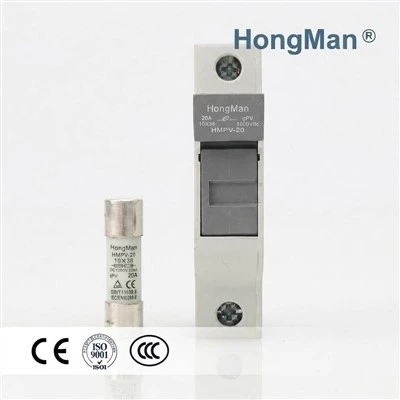
Before I wrap up, one last pro tip: always keep an extra fuse for every size in your panel, and stow a few spares in your glove box or tool bag. Nothing kills a camping vibe like driving an hour to a gas station that sells 10-amp fuses when you need a 15.
NH Fuse Link References:
- National RV Maintenance Association, “DC Electrical System Safety for Recreational Vehicles,” 2022.
- SAE International, “Standard for Automotive DC Fuse Ratings,” J1284, 2021.
- RV Education 101, “Basic Electrical Calculations for RVs,” Educational Series, 2020.
Zhejiang Hongman Electric Technology Co., Ltd.
Zhejiang Hongman Electric Technology Co., Ltd. is one of the most professional dc energy fuse manufacturers and suppliers in China. We have world-leading production equipment and strong manufacturing capabilities. Please feel free to wholesale bulk cheap dc energy fuse from our factory. All customized products are with high quality and competitive price.
Address: 115 XinGuang Avenue,XinGuang Industrial Zone, Liushi Town, Yueqing City, Zhejiang Province. China
E-mail: mia@chinahongman.com
WebSite: http://www.cnfuse.com/
