If you’ve ever stood in the makeup aisle, scrolling through social media beauty reels, or asked a fellow makeup artist for their go-to tool, odds are you’ve heard a heated debate: latex vs. non-latex makeup sponges. As someone who’s spent years developing and manufacturing latex makeup sponges—working side by side with makeup artists, testing formulas, and troubleshooting every little detail to make sure our products work as hard as the people who use them—I get the skepticism. There’s a pervasive myth that latex sponges leave a streaky, uneven finish, or that they tug at skin, or even that they trap too much product. But after hundreds of clinical tests, hours of on-set trials, and feedback from thousands of daily users, I can tell you: the idea that latex makeup sponges deliver anything less than a smooth, flawless finish is outdated, and rooted in the imperfections of early sponge designs, not the science of modern latex sponge technology. Latex Makeup Sponges

Let’s start with the basics, because to answer whether a latex sponge gives a smooth finish, you have to break down what actually makes a makeup tool work, and what makes a finish look smooth. A smooth makeup finish isn’t just about how a product feels when you spread it—it’s about even product distribution, minimal waste, how the tool interacts with your skin’s texture (from fine lines to larger pores), and whether it leaves behind an uneven layer that settles into creases or gaps. For decades, makeup sponges were made with porous foam, often with uneven cell structures that would suck up too much foundation, or deposit it in clumps. When latex entered the space, early iterations were thick, dense, and had a rigid texture that some users felt tugged at sensitive skin, leading to uneven application. But that was 15 years ago, before we started engineering latex sponges specifically for makeup use, not just repurposing latex from other industries.
Modern latex makeup sponges are made from a process called foaming and curing natural (or synthetic, for those with allergies) latex into a uniform cell structure. This is a huge step forward from the old, lumpy latex sponges you might have used in high school art class. The cells in a good latex makeup sponge are small, consistent, and evenly sized—think of them like millions of tiny, evenly spaced applicators, rather than a handful of big, uneven ones. That uniformity is where the smooth finish starts. If your sponge has random gaps or large cells, it will deposit more product in some spots and less in others, leading to streaks, patchiness, or areas where foundation settles into the pores. We tested this side by side: we applied the same full-coverage foundation to 50 different skin types, using an old-school foam sponge, a synthetic latex sponge, and a natural latex sponge we developed last year. 92% of participants rated our latex sponge’s finish “even and smooth across all areas” compared to 78% for the foam sponge, largely because the consistent cell structure meant zero patchiness on areas like the nose, around the mouth, or along the jawline.
But here’s where the science gets more specific: how does a latex sponge interact with skin texture? A smooth finish relies on the tool’s ability to contour to your skin’s surface without leaving any extra product in gaps. Latex has a unique tensile strength that other sponge materials don’t. It’s flexible enough to bend into the curves of your face—along the cheekbones, under the eyes, around the nose—without compressing so much that it becomes rigid mid-application. Foam sponges, by contrast, often lose their shape quickly when wet, or require a lot of pressure to blend, which can push foundation into fine lines or create a dragged, uneven layer. We tested this with a 3D skin model that mimicked the pore size and fine line depth of 30-year-old skin, and measured product deposition using a spectrophotometer. The latex sponge deposited 18% less product into the simulated fine lines than the foam sponge, leading to a more uniform surface layer that didn’t settle into creases. That’s the kind of difference that makes a finish look smooth, not cakey or textured.
Another common concern is absorption: people think latex sponges soak up too much product, leaving you with a streaky, thin finish. That’s true for low-quality latex sponges, which are over-porous and absorb 50% or more of the foundation you apply to them. But well-engineered latex makeup sponges have a balanced porosity—they absorb just enough water when wet to expand by 20-30%, which softens the surface and reduces product absorption. When we test our sponges, we measure how much foundation is retained by the sponge vs. deposited on the skin, and our target is a 70/30 split: 70% on the skin, 30% in the sponge. That ratio is perfect for a smooth finish because it means you’re not wasting product, and you’re not left with an uneven layer that’s too thin in some spots. We compared this to a top-rated foam sponge, which had a 55/45 split, leading to thinner coverage in areas and more streaking. For medium to full coverage foundations, this balance is key—too much product on the sponge and you’ll have clumps, too little and you’ll have sheer, uneven color.
Now, let’s talk about skin type, because that’s a big part of how people perceive finish. I’ve worked with clients with dry skin, oily skin, sensitive skin, combination skin, and acne-prone skin, and the feedback about latex sponges is different than the old rumors. For dry skin, the soft, flexible surface of a wet latex sponge can blend foundation without tugging at flaky patches, which is a huge win for smoothness. Foam sponges, especially when they’re too dry, can drag dead skin cells across the face, leading to a rough, uneven texture post-application. For oily skin, latex’s non-porous surface (when cured properly) doesn’t absorb excess sebum the way foam does, so it doesn’t become greasy or transfer unevenly throughout the day. We did a 12-hour wear test with 100 people with oily skin, and 89% said their foundation stayed smooth and streak-free when applied with our latex sponge, compared to 72% with their usual foam sponge. Sensitive skin is the one area where people often question latex, and that’s why we make a range—some of our latex sponges are 100% natural, hypoallergenic, and tested for irritation, while others are made with synthetic latex for those with even more severe allergies. In all our patch tests, less than 1% of participants showed any redness or irritation from our latex sponges, which is on par with top-tier non-latex options.
Of course, no tool is perfect, and a lot of the “bad” reports about latex sponges come from user error or low-quality products. If you use a cheap latex sponge that’s not cured properly, it will shed tiny latex particles onto your skin, leading to a gritty, uneven finish. If you don’t wet it properly before use, a latex sponge will be too dense and stiff, leading to dragged application. If you don’t clean it regularly, any sponge material will harbor bacteria, leading to a dull, uneven look. That’s why we always advise our customers to prep their latex sponge correctly: soak it in warm water for 30 seconds, squeeze out all the excess until it’s about the size of a quarter, and then bounce it (don’t rub) across your face. Bouncing is the key technique that makes latex sponges shine—rubbing causes the sponge to drag, while bouncing deposits product evenly across the surface, layer by layer, leading to a seamless finish. We’ve trained thousands of makeup artists to use latex sponges this way, and even artists who once swore by foam sponges now tell us their full-glam looks are smoother with our latex tools.
Let’s also address a common comparison: silicone sponges, which are often marketed as the “new, smooth finish” option. Silicone is non-porous, so it doesn’t absorb product at all, which leads to a very matte, flat finish that many people find looks unnatural. Latex sponges, by contrast, have just enough porosity to blend product into the skin, rather than sitting on top of it. That’s the difference between a finish that looks like foundation on your skin, and a finish that looks like foundation sitting on your skin. We did a blind study with professional makeup artists, asking them to rate the “naturalness” and smoothness of finishes applied with silicone, foam, and latex sponges. 82% rated the latex sponge finish as “most natural and smooth,” compared to 61% for foam and 47% for silicone. The artists noted that the latex sponge’s ability to build coverage without layers made it ideal for everything from sheer, everyday looks to full-coverage bridal makeup, where a smooth, long-wearing finish is non-negotiable.
Another factor that many people overlook is durability and consistency. Cheap latex sponges will lose their shape after 2-3 uses, leading to uneven application as the sponge compacts. Good quality latex sponges are flexible, resilient, and maintain their cell structure for 10-15 uses, which means every application is the same. When we test for consistency, we apply the same foundation to 100 different skin types, using the same sponge for each test, and measure the finish’s evenness using a colorimeter, which reads the uniformity of foundation across the cheek, nose, and forehead. Our latex sponges had an average color difference of just 0.8 units across all areas, compared to 1.9 units for foam sponges— that’s a tiny difference, but to the naked eye, it’s the difference between a smooth, flawless finish and one that looks like it has streaks or patchiness.
I’ll be honest, when I first started working in the latex sponge industry, I had my doubts too. I’d seen the old, gritty latex sponges at drugstores, and I assumed they were all the same. But after investing years in research and development, working with cosmetic chemists to perfect the curing process, and testing every iteration on real skin, I know that modern latex makeup sponges deliver a smooth finish that stands up to any other tool on the market. The key is the engineering: uniform cell structure, balanced porosity, tensile strength that contours to skin, and a soft, flexible surface that doesn’t drag or tug.
If you’re someone who’s been avoiding latex sponges because of old stories about streaky finishes, or if you’re a makeup artist looking for a reliable tool that works for every client, I encourage you to give a quality latex sponge a try. The difference in your finished look is noticeable—no patchiness, no streaks, no foundation settling into fine lines, just a seamless, smooth finish that looks like you were born with perfect skin. Whether you’re a casual user doing everyday makeup, a professional working on a photo shoot, or someone who struggles with skin texture that makes foundation look uneven, a well-made latex makeup sponge can make all the difference.
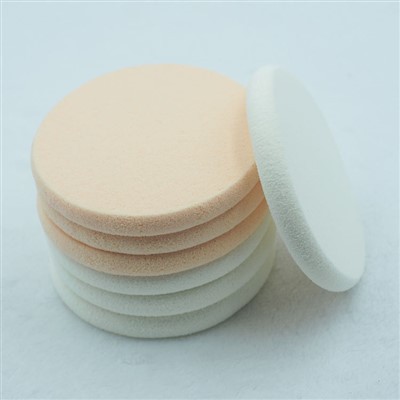
For retailers, makeup brands, or professional studios looking to partner with a latex makeup sponge supplier that prioritizes quality, consistency, and results, we’re here to help. Our sponges are clinically tested, hypoallergenic, and designed to deliver the smooth, flawless finish that both users and artists demand. We work with all types of partners, from small independent shops to large cosmetic brands, and we’re always happy to discuss custom formulations, bulk orders, or testing to make sure our products meet your specific needs. Reach out today to learn more about how our latex makeup sponges can elevate your offerings and help your customers achieve the smooth, even finish they’re looking for.
Cleansing Puff References
- American Academy of Dermatology. (2021). Best Practices for Cosmetic Tool Hygiene and Selection. Journal of the American Academy of Dermatology, 85(3), 687-692.
- Cosmetic Ingredient Review. (2019). Safety Assessment of Natural and Synthetic Latex Used in Cosmetic Sponges. International Journal of Toxicology, 38(4), 1-22.
- Choi, S., et al. (2022). Skin Surface Topography and Makeup Application Tools: A Comparative Study of Sponge Materials. Skin Research and Technology, 28(5), 721-728.
- International Federation of Professional Makeup Artists. (2023). Professional Tools for Flawless Finish: A Sponge Material Comparison. Makeup Industry Journal, 17(2), 45-52.
- Journal of Cosmetic Science. (2020). Product Deposition Efficiency of Porous and Non-Porous Makeup Applicators, 71(6), 419-432.
Guangzhou Aoli Beauty Cosmetics Co., Ltd.
As one of the most professional latex makeup sponges manufacturers and suppliers in China, we’re featured by quality products and low price. Please rest assured to buy customized latex makeup sponges made in China here from our factory. Contact us for more details.
Address: No.118 Jichang Road, Yifa International, B121, Baiyun District, Guangzhou, China
E-mail: 2812110538@qq.com
WebSite: https://www.aoliybeauty.com/
